

Ankle Arthritis Treatment in Los Angeles
Seventy percent of arthritis in the ankle is caused by prior trauma, known as post-traumatic arthritis. Dr. Alexis Dixon, MD, FAAOS, a board-certified orthopaedic foot & ankle surgeon in Marina Del Rey, diagnoses and treats ankle arthritis.
Foot & Ankle Conditions
What Is Ankle Arthritis?
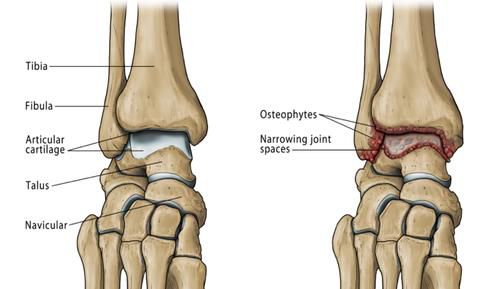
Arthritis is the wear of cartilage inside the joint. The cartilage acts as a nearly frictionless surface to allow for smooth motion. When the cartilage deteriorates, the bone rubs against bone, which is painful. Inflammation within the joint is also painful.
The ankle is a complex joint formed by three bones: the tibia forms the roof and medial side, the fibula is a buttress for the lateral side, and the talus acts as the hinge inside the mortise. It is a table joint that allows for the flexion and extension of the ankle, with minimal side to side motion. It is largely unaffected by arthritis in the way that the hip and knee are, and simple wear and tear arthritis is uncommon.
Get an Accurate Diagnosis
Diagnosis
A set of high-quality weight-bearing (standing) x-rays are required for diagnosis, as well as a thorough physical examination. Sometimes, an MRI and CT scan may be necessary.

Symptoms
In its early form, it may be isolated to a bone spur on the anterior portion of the joint, leading to decreased range of motion and a sensation of “pinching.” More severe arthritis is complete cartilage loss and cyst formation.
Almost fifty percent of people in their 60s and 70s have arthritis in the foot or ankle, but not all these people notice symptoms or experience pain.
What Causes It?
Seventy percent of arthritis in the ankle is caused by prior trauma, known as post-traumatic arthritis. This can be trauma as serious as a fracture that disrupts the end of the tibia, a simple fracture to the fibula, or even an ankle sprain leading to chronic instability.
Conservative First, Surgical When Needed
Treatment Options
Nonsurgical
Oral anti-inflammatories and ice
The use of NSAIDs and ice will help to minimize the pain significantly day to day. Taking two Aleve twice a day for two weeks, as a trial, can show how much NSAIDs will minimize pain. Topical NSAIDs are also available by prescription. Ice should always be wrapped in a tea towel and applied for no more than fifteen minutes every hour to prevent frostbite. It should be done at least twice a day but not more than once an hour.
Activity modification
Reducing aggravating and high duration activities will help to alleviate pain. Impact activities will always be more painful on an arthritic ankle. Cross training with swimming or an elliptical machine, and avoidance of aggravating activities, can result in less pain.
Temporary immobilization
A brace or boot can be helpful during severe flares of pain.
Physical therapy
Regular physical therapy sessions can help to retrain gait and strengthen the muscles around the ankle to normalize motion and minimize pain. It will not reverse the arthritis but can greatly decrease the pain.
Orthotics
These will work to normalize the foot’s contact with the ground and offload areas of pressure.
Injections
Injections can be performed to help with pain. There are three main types of injections used for arthritis:
- Anti-inflammatory injections are steroid injections, which decrease inflammation. They may help some of the pain from swelling within the joint. They do carry the risk of damage to the cartilage over time and should be used judiciously.
- Lubricant injections are made of glycoproteins that occur naturally in joint fluid. Arthritis disrupts the normal concentrations of glycoproteins in joint fluid, and the lubricant injections help to restore a more normal lubricant joint fluid. These are off label in the ankle and may not be covered by insurance but many patients find them to be helpful.
- Biologic injections include stem cells and PRP (platelet rich plasma). Without help, cartilage is not repaired by the body. The goal of these injections is to stimulate the body’s healing responses above normal levels to allow for healing of injured cartilage. PRP, which is commonly used, is drawn from your own blood to stimulate the inflammatory pathways that create cartilage. This may allow for some healing. These are not usually covered by insurance.
Surgery
Occasionally this is necessary when the pain is not able to be treated non-operatively. The specific surgery required is dictated by the severity of the arthritis, as well as other factors.
For young patients with only an anterior osteophyte or bone spur, simple removal of the bone spur may alleviate a significant portion of the pain and allow for better range of motion. For severe arthritis, an ankle fusion or replacement may be necessary.
A fusion welds the joint together to completely rid the ankle of any arthritis or pain. The numerous joints that surround the ankle allow for near-normal motion afterwards. This surgery does not need to be redone.
An ankle replacement is a complex procedure where the joint is replaced by metal and plastic parts. Because it is a very delicate operation, only certain patients are good candidates for this. An ankle replacement is not intended for heavy use or impact activity, so is more commonly recommended in an older and more sedentary population. Revision surgery is commonly required in 10 to 20 years.
Why See a Board-Certified Orthopaedic Surgeon (MD)?
For best results, see a board-certified orthopaedic surgeon with accredited fellowship training in foot and ankle surgery about your ankle. Foot and ankle orthopaedic surgeons complete medical school, five years of residency training in orthopaedic surgery, and a yearlong advanced fellowship focused on foot and ankle care.
Dr. Dixon is a board-certified orthopaedic foot & ankle surgeon, not a podiatrist. She is a Fellow of the American Academy of Orthopaedic Surgeons (FAAOS), which requires six years of post-graduate training. The specific surgery required for an arthritic ankle is dictated by the severity of the arthritis, as well as other factors, and the options run from simple removal of a bone spur to an ankle fusion or an ankle replacement.
After Treatment
What Recovery Looks Like
Taking two Aleve twice a day for two weeks, as a trial, can show how much NSAIDs will minimize pain. Physical therapy will not reverse the arthritis but can greatly decrease the pain, and a brace or boot can be helpful during severe flares of pain.
For surgery, the specific procedure required is dictated by the severity of the arthritis, as well as other factors. An ankle fusion does not need to be redone. With an ankle replacement, revision surgery is commonly required in 10 to 20 years.
Recovery after surgery depends on the procedure. Dr. Dixon reviews the expected timeline with you before surgery.
What Patients Say
Patient Reviews
Patient Questions
Ankle Arthritis FAQs

About Your Surgeon
Alexis E. Dixon, MD, FAAOS
Dr. Dixon is a board-certified orthopaedic foot & ankle surgeon practicing in Marina Del Rey, California. USC-trained and named an LA Magazine Top Doctor since 2017, she combines surgical expertise with a conservative-first philosophy, treating the underlying joint and tendon, not just the symptom. She treats ganglion cysts, bunions, Achilles injuries, plantar fasciitis, fractures, and the full range of foot and ankle conditions.
Meet Dr. Dixon →Ankle Pain That Keeps Coming Back? Get a Real Diagnosis.
Get an accurate diagnosis and a clear plan from a board-certified orthopaedic foot & ankle surgeon in Marina Del Rey.
Sources
References
The patient handout for this condition draws on the following sources.